
特朗普又开除了一位:Health and Human Services Secretary Tom Price

  • 主题发起人 主题发起人 ccc
  • 开始时间 开始时间
upload_2017-10-7_16-11-1.png


(CNN) Lawyers, diplomats and strategists take note: If you're going to work for Donald Trump, there's a good chance you're going to have to squirm.

A pattern is emerging for administration officials that goes something like this: a slight, real or imagined, against the boss is followed by reports that the boss is displeased, which is then followed by either a public show of fealty -- or a firing. Or both.

To whom does this apply, in one way or another? Only Sean Spicer, Anthony Scaramucci, Reince Priebus, Steve Bannon, Sally Yates, James Comey, Michael Flynn and, most recently, Tom Price. That's a lot of names, with very different backgrounds but oddly similarly life cycles.

This week it was Rex Tillerson's turn.
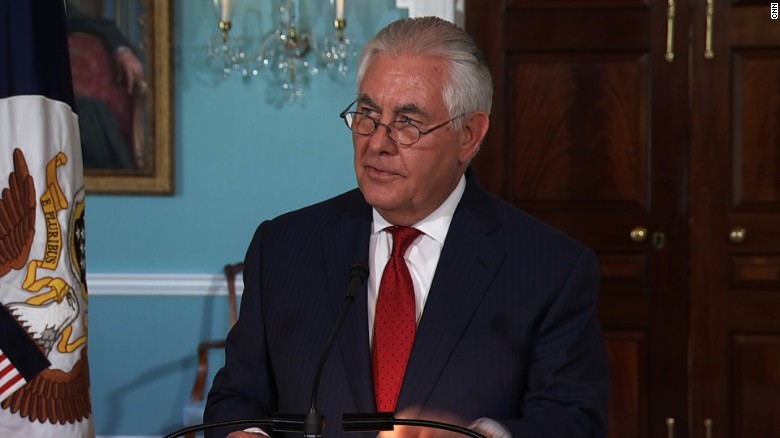
171004110034-rex-tillerson-exlarge-169.jpg

Rex Tillerson addresses rumors on quitting

The former ExxonMobil CEO turned Trump secretary of state wasn't fired, but instead found himself at a hastily arranged news conference trying to reaffirm his commitment to Trump.

Tillerson's public proclamation closely followed an NBC report that he had considered leaving the administration (which he has denied) and that he'd called his boss a "moron." He didn't quite deny the latter bit, instead saying he wouldn't entertain any questions on it either.

That's a solid deflection, but Tillerson has been in the Trump administration since February -- long enough to see this kind of silliness coming. He's seen the dismissal of a cadre of White House advisers, the firing of one Cabinet colleague and the public humiliation of another.

Trump's top diplomat still has his job at this writing. And so does his top lawyer. But back in July it was Attorney General Jeff Sessions who was swearing loyalty to his boss at a public press conference, promising to do his best for the administration and saying he had no intention of resigning. Remember that?

170720102610-01-sessions-presser-0720-exlarge-169.jpg

Sessions: I plan to continue as attorney general

Sessions' crime, in Trump's eyes, was acquiescing to DC's news and political class by recusing himself from the Russia probe, paving the way for his deputy to appoint a special counsel to head it up. That investigation has only grown since then, so Trump's anger is easy to understand.

Price, Tillerson and Sessions are Trump hires, so the drama around them is distinct from the spectacular firings of Sally Yates, the acting attorney general who chose not to follow his travel ban directive, or James Comey, the non-partisan FBI director who, in so frequently -- and perhaps flagrantly -- exerting his independence, has drawn fire from both sides of the aisle.

White House staffers are in a different category than Cabinet secretaries and those outside the administration. For them, the cycle is greased with gossipy leaks, Trump being frustrated with this person or badgering another.

There is less space for public squirming -- it's either a swift dismissal or acceptance of resignation. That was the model for Spicer, who resigned. Bannon, Priebus, Anthony Scaramucci and Sebastian Gorka were all shoved out with varying degrees of force. Their post-White House efforts have diverged, with Bannon carrying on his nationalist fight and trying to influence the party, Spicer and Scaramucci trying to rehab their images and Priebus laying low.

Michael Flynn's firing -- the first of the Trump administration -- was notable because of the soap opera that took shape around it, as chatter around his contacts with Russians grew. Interestingly though, and another indication of the odd ways of this White House, Trump, according to a Politico report, later told aides he regretted it.

Chris Cillizza wrote on CNN Friday that Trump was treating a potential war like a "reality show cliffhanger." Something similar could be said of the drama inside his Cabinet. It was only last week that he fired his HHS secretary, Price, amid a still-bubbling scandal centered on the use of expensive private jets, billed to taxpayers, by Cabinet officials.

That drama has been moved to the back burner a week later, replaced by the next episode, the tensions surrounding his secretary of state.

The big question going forward: Who will it be next week?
 
Rex Tillerson should quit now
By Julian Zelizer, CNN Political Analyst
Updated 2:36 PM ET, Sat October 7, 2017

Editor's Note: Julian Zelizer is a history and public affairs professor at Princeton University and the author of "The Fierce Urgency of Now: Lyndon Johnson, Congress, and the Battle for the Great Society." He's also the co-host of the "Politics & Polls" podcast. The opinions expressed in this commentary are his own.

(CNN) If Secretary of State Rex Tillerson is unhappy with the way that President Donald Trump is conducting his White House, he should resign, and he should do so soon and in a very public way.

Over the past few weeks there has been growing evidence that Tillerson disapproves of Trump's performance in office. The secretary, who arrived at Foggy Bottom without any government experience or a close connection to Trump, has been forced to sit on his hands as the President has marginalized him, criticized him and moved in a different direction on key issues such as North Korea than the cautious former oil executive would seem to prefer.

Tillerson has tried to clean up Trump's messes, but to little avail. In what some have compared to a hostage video, the secretary had to take questions on camera this week after stories emerged on NBC that he had seriously considered resigning in July and had called the President a "moron."

It might be true, as Senate Foreign Relations Chairman Bob Corker told the press, that Tillerson is one of the few people protecting the United States from total chaos. But it is not certain that staying in the job is actually making things better. In fact, there is an argument to be made that, if Tillerson really is unhappy, the best thing he could do is to undertake a major act of political courage by leaving the administration and triggering the kind of ripple effect on Capitol Hill urgently needed to wake Republicans from their politically induced slumber.

There have been a few Cabinet and other senior officials who have resigned in protest over the years. Secretary of State William Jennings Bryan left President Woodrow Wilson's administration in 1915 because he felt the administration was taking an unnecessarily militaristic path in Europe.

Dean Acheson resigned in 1933 as treasury undersecretary in opposition to Franklin Roosevelt abandoning the gold standard. Attorney General Elliot Richardson announced his resignation in October 1973 after President Richard Nixon ordered him to fire Archibald Cox, the special prosecutor investigating Watergate. Department of Health and Human Services adviser Peter Edelman left the Clinton administration to protest the welfare reform law in 1996.

When Cabinet officials continue to work for a president with whom they have fundamental disagreements, nothing good ever really comes of it. They often serve as public figures who legitimize disastrous presidential decisions.

The most famous case of inaction was Defense Secretary Robert McNamara, who privately wrestled with the war in Vietnam, understanding the futility of the mission as well as the high toll it was taking on working-class and lower middle-class American families, yet refused to break with President Lyndon Johnson in 1968.

Johnson depended on McNamara's brilliance and executive credentials to push back against left-wing critics who said the President was making a horrendous mistake in Vietnam. Remaining in the administration and remaining silent did nothing to check the disastrous war, which only got worse during McNamara's time at the Pentagon.

While it is true that many of these resignations ultimately didn't stop the policies being protested, they were important moments that energized constituencies who were unhappy and were opposing the president. Resignations have become rallying points for the opposition.

Sometimes unhappy Cabinet officials can have a beneficial effect by staying on the job. But not with Trump.

Doing something is increasingly urgent as it becomes clear that the so-called adults in the room have almost no ability to control this President. Defense Secretary James Mattis has not been able to restrain Trump from greatly heightening the potential of serious military conflict on multiple fronts.

Chief of Staff John Kelly has failed to stop the President from delivering incendiary comments. National security adviser H.R. McMaster has not been able to persuade Trump to develop a coherent plan for dealing with the world's threats, and Tillerson has found it difficult to protect the diplomatic option from becoming a marginal part of the administration's agenda.

In the case of Tillerson, his resignation has the potential to have an even bigger effect than many we have seen, given Trump's paper-thin support. Some congressional Republicans are unhappy with the direction of his presidency, while his approval ratings have been extremely low. Democrats, who never liked Trump, have only seen their worst fears confirmed as each day of this presidency continues.

What would Tillerson stepping down accomplish? At a minimum, it would be the first time that a major official took a principled stand against the tumult that has been unfolding in the White House, potentially inspiring others to do the same and creating a sense of crisis for Republican power brokers that moves them to apply more pressure on the advisers surrounding the President.

It could create space for the appointment of a person such as Nikki Haley, US ambassador to the United Nations, who can prove to be much more politically savvy in pushing the diplomatic agenda than Tillerson, who has stumbled repeatedly in the rough ways of Washington.

More important, Tillerson's resignation could finally motivate congressional Republicans to be more forceful in pushing back through legislation, as they did with the sanctions bill that tied the hands of Trump, through oversight and investigation or possibly challenging the President's competence through the 25th Amendment should the situation reach that point.

Since we are reaching a critical moment with North Korea as well as Iran, Tillerson's resignation would send a particularly urgent message. His departure could also help shape the politics of the 2018 midterm elections in ways that creates a Congress populated with more legislators who will serve as a forceful check against the President. It could also energize potential challenges from Republicans seeking to take on Trump in the 2020 primaries who could put the United States on a more stable course abroad.

Too often Cabinet officials remain silent. One aide once said of Secretary of State John Foster Dulles, "I saw the secretary of state sitting in his office, wrestling with his conscience. Of course, he won."

Rather than allowing the President to use him to pretend there is any serious interest in diplomacy within this White House, Tillerson, if he is interested in having an impact on foreign policy, should consider stepping down and then making it clear on the cable news shows that Trump so eagerly watches why he feels this kind of presidency can't continue for much longer.
 
Vice President Mike Pence's brief appearance at an Indianapolis Colts game Sunday — which he left in protest after several players knelt during the national anthem — most likely cost taxpayers more than $250,000.

The cost of flying Air Force Two from Las Vegas — where Pence on Saturday attended a memorial event for victims of the shooting there last week — to Indianapolis was roughly $100,000, CNN reported.

After his early exit from the game, he flew to Los Angeles to attend a Monday fundraiser for Republican Rep. Dana Rohrabacher; that flight cost about $142,500, CNN reported.
 
Vice President Mike Pence's brief appearance at an Indianapolis Colts game Sunday — which he left in protest after several players knelt during the national anthem — most likely cost taxpayers more than $250,000.

The cost of flying Air Force Two from Las Vegas — where Pence on Saturday attended a memorial event for victims of the shooting there last week — to Indianapolis was roughly $100,000, CNN reported.

After his early exit from the game, he flew to Los Angeles to attend a Monday fundraiser for Republican Rep. Dana Rohrabacher; that flight cost about $142,500, CNN reported.


肉烂在锅里
 
前三位是DONALD TRUMP, IVANKA TRUMP, JARED KUSHNER?

我说错了,应该是第五位。

upload_2017-10-9_17-35-14.png
 
It's a period now.

upload_2017-10-10_9-46-43.png


upload_2017-10-10_9-47-15.png

upload_2017-10-10_9-49-25.png

upload_2017-10-10_9-50-6.png

upload_2017-10-10_9-50-44.png
 
后退
顶部
首页 论坛
消息
我的