
您正在使用一款已经过时的浏览器!部分功能不能正常使用。
请尝试升级或使用 其他浏览器。
请尝试升级或使用 其他浏览器。
世界卫生组织正式宣布
- 主题发起人 ottawa_tj
- 开始时间


- 注册
- 2003-04-13
- 消息
- 238,525
- 荣誉分数
- 37,865
- 声望点数
- 1,393

- 注册
- 2005-11-23
- 消息
- 29,989
- 荣誉分数
- 7,575
- 声望点数
- 373
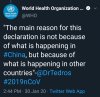
WHO的声明对中国控制疫情仍然给与很高的评价。
Tedros said Thursday that the declaration doesn’t mean the agency has a “vote of no confidence in China.” He congratulated the Chinese government for their efforts to contain the outbreak despite the potential economic impacts.
Tedros said Thursday that the declaration doesn’t mean the agency has a “vote of no confidence in China.” He congratulated the Chinese government for their efforts to contain the outbreak despite the potential economic impacts.


- 注册
- 2005-11-23
- 消息
- 29,989
- 荣誉分数
- 7,575
- 声望点数
- 373
Coronavirus: WHO declares international health emergency
The UN's health arm said the announcement was "to protect countries with weaker health systems."

The World Health Organization (WHO) on Thursday to declared the coronavirus that originated in China a public health emergency of international concern, as the United States reported its first case of person-to-person transmission.
The health agency described the emergency as an "extraordinary event" that constitutes a risk to other countries and requires a coordinated global response.
Tedros Adhanom Ghebreyesus, the WHO's Director-General, said: "This declaration is to protect especially countries with weaker health systems and to prepare for that."
Tedros was effusive in his praise of how China have gone about dealing with the crisis, describing the country as a benchmark for handling such outbreaks. "In many ways China is setting a new standard for outbreak response."
The WHO chief continued: "The Chinese government is to be congratulated for the extraordinary measures it has taken to contain the outbreak, despite the severe social and economic impact those measures are having on the Chinese people."
"We would have seen many more cases outside China by now – and probably deaths – if it were not for the government’s efforts, and the progress they have made to protect their own people and the people of the world."
"The speed with which China detected the outbreak, isolated the virus, sequenced the genome and shared it with WHO and the world are very impressive, and beyond words. So is China’s commitment to transparency and to supporting other countries."
The death toll from the new virus currently stands at 170 and the number of reported cases at well over 8,000. It has now infected more people in China than were affected during the outbreak of SARS, a relation of the coronavirus.
The WHO made the global concern declaration after it was revealed that eight of the deaths related to the virus had occurred outside of the outbreak's epicenter, China's Hubei province.
Last week, the UN organization decided against this top-level health billing when the death toll was below 50. However, consensus seemed to be changing this week as the reported deaths continued to increase as the body said it "regrets" previously calling the virus risk "moderate."
WHO chief said the issue needed to be re-evaluated after human-to-human infections started occurring outside of China. The first transmission of this kind in Europe was reported in Germany while the United States, Japan, Taiwan, Vietnam and South Korea have all noted the disease under the same circumstances.

 www.dw.com
The UN's health arm said the announcement was "to protect countries with weaker health systems."
The World Health Organization (WHO) on Thursday to declared the coronavirus that originated in China a public health emergency of international concern, as the United States reported its first case of person-to-person transmission.
The health agency described the emergency as an "extraordinary event" that constitutes a risk to other countries and requires a coordinated global response.
Tedros Adhanom Ghebreyesus, the WHO's Director-General, said: "This declaration is to protect especially countries with weaker health systems and to prepare for that."
Tedros was effusive in his praise of how China have gone about dealing with the crisis, describing the country as a benchmark for handling such outbreaks. "In many ways China is setting a new standard for outbreak response."
The WHO chief continued: "The Chinese government is to be congratulated for the extraordinary measures it has taken to contain the outbreak, despite the severe social and economic impact those measures are having on the Chinese people."
"We would have seen many more cases outside China by now – and probably deaths – if it were not for the government’s efforts, and the progress they have made to protect their own people and the people of the world."
"The speed with which China detected the outbreak, isolated the virus, sequenced the genome and shared it with WHO and the world are very impressive, and beyond words. So is China’s commitment to transparency and to supporting other countries."
The death toll from the new virus currently stands at 170 and the number of reported cases at well over 8,000. It has now infected more people in China than were affected during the outbreak of SARS, a relation of the coronavirus.
The WHO made the global concern declaration after it was revealed that eight of the deaths related to the virus had occurred outside of the outbreak's epicenter, China's Hubei province.
Last week, the UN organization decided against this top-level health billing when the death toll was below 50. However, consensus seemed to be changing this week as the reported deaths continued to increase as the body said it "regrets" previously calling the virus risk "moderate."
WHO chief said the issue needed to be re-evaluated after human-to-human infections started occurring outside of China. The first transmission of this kind in Europe was reported in Germany while the United States, Japan, Taiwan, Vietnam and South Korea have all noted the disease under the same circumstances.
Coronavirus: WHO declares global health emergency – DW – 01/30/2020
The UN's health arm said the move was to protect countries with "weaker health systems." However, the WHO also said there was no reason for measures that unnecessarily interfere with international travel and trade.
www.dw.com

- 注册
- 2004-02-10
- 消息
- 12,869
- 荣誉分数
- 3,046
- 声望点数
- 373

WHW
三毛移民记
- 注册
- 2006-08-06
- 消息
- 7,100
- 荣誉分数
- 1,254
- 声望点数
- 323
你懂的!为啥拒绝?


茶马盐铁
我想看看自定义头衔到底能有多少字。继续加,看系统什么时候把这个字符串截断。呃,居然还有?那就继续吧。
- 注册
- 2015-08-14
- 消息
- 33,443
- 荣誉分数
- 9,616
- 声望点数
- 373
这老小子解释了半天, 安抚了半天,好一副委屈的样子。 不过没用, 跟中国的这个梁子,算是结下了。
习总刚刚才亲自接见了他, 亲自跟他解释了一切, 并亲自跟他握手,亲自合影。
没想到这小子一转眼,就把中国给卖了!
下次别想到中国来了, 这次还有好酒,下次就剩下猎枪了!
世卫组织还想问中国拿钱, 门儿都没有!
相关推荐


- 回复
- 0
- 查看
- 11K
